
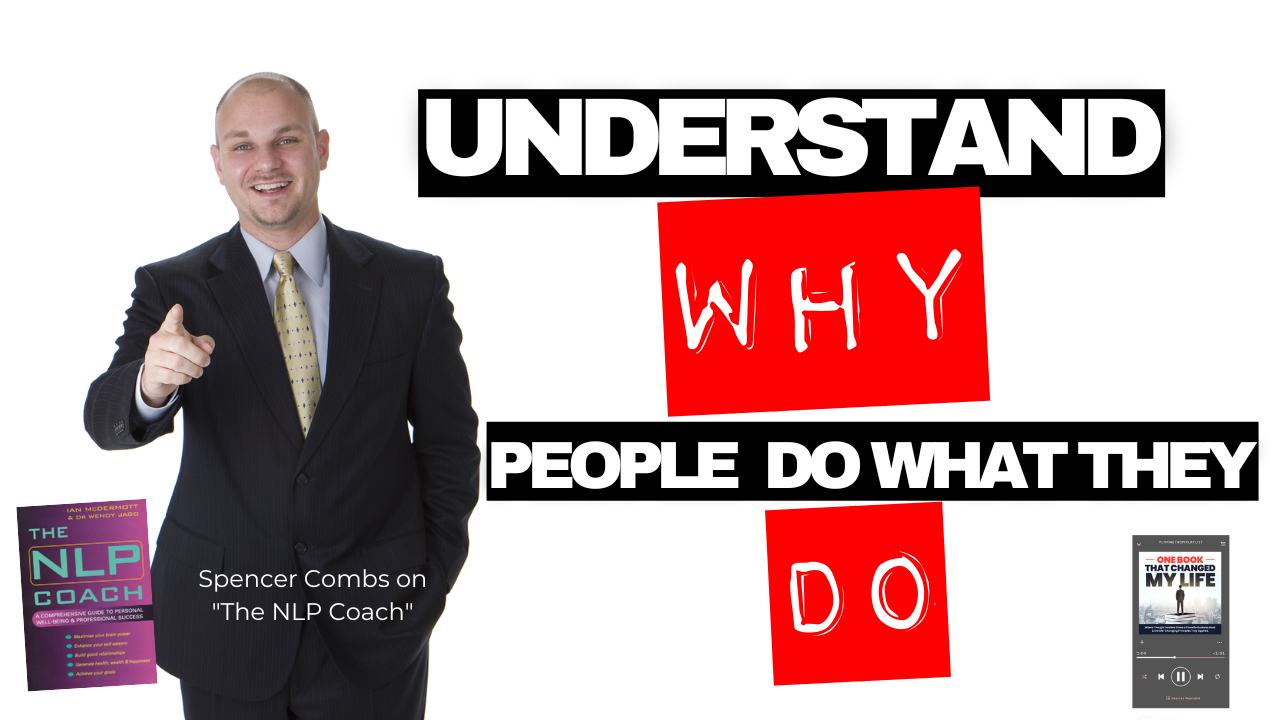
One Book that changed my life podcast

I had the privilege to get behind the mic along with Matt Johnson of Microfamous fame and loved it.  We went into a few things and Matt actually summed it up best with these 3 things that we covered:  
Picture
Here is the excerpt from Matt's Blog:  

Three Things You’ll Learn In This Episode

How Spencer’s journey led to him being a coach
Many people who are in a coaching role have had some level of trauma in their childhood or youth in some way, shape or form. Those experiences create a dynamic where you’re curious about why people do what they do.


Using NLP to change the inner track of our thoughts 
Most of us have a life because of the story we’re telling ourselves. If we figure out how to change the story, we can change our lives. If we fuse with the story, we’ll accept it, internalize it and it starts to filter through the way we see reality, it starts to color our actions and the results we get.


How Spencer creates Aladdin moments for his coaching clients
Meta-Programs are the thing Spencer keeps coming back to years after reading “The NLP Coach”. All of us are wired to act a certain way, but there are ways to engineer this wiring so we can get better results. Meta-Programs open us up to new perspectives, and which allows us to see a whole new world and make change possible.

Check out the podcast Here: 

Website
Apple Podcasts
Spotify

Keep well and keep moving forward, 

​Spencer

Comments

Here's what others like you are reading:

50 Cent, Government Cheese, and the Science of the Qualified Champion

The "Gangster" Paradox: Why Autonomy is the Ultimate Un-Goal The word "gangster" carries a lot of baggage. For most, it conjures images of the street, the hustle, or the headlines. But in his recent Esquire sit-down, 50 Cent stripped away the theater and gave us a definition that belongs on every entrepreneur’s whiteboard: "To me, gangster means to live the way you like without answering to anyone." Read that again. He’s not talking about crime; he’s talking about agency . He’s talking about the " Un-Goal ." The "Should" Monster vs. The Un-Goal In my work with the WRAP Sheet and Momentum & Mastery , we talk constantly about the " Should Monsters ." These are the invisible anchors—the projects you took on because a competitor did, the clients you tolerate because you’re afraid of the gap in your calendar, and the "hustle" habits that steal your emotional capital. Most people spend their entire careers building ...

The Freedom of the Un-Goal

The calendar is almost done. And you know what that means. The 'Should' monsters are waking up. They are the goals, the projects, the expectations you carry around that don't actually belong to you. You should launch that huge, complex product. You should be on that social platform where all your competitors are making noise. You should chase that client segment that is exhausting and doesn't pay. These "shoulds" are anchors. They drain your emotional capital, clutter your WRAP Sheet , and steal the energy you need to execute on the real high-leverage assets. Most people treat the New Year like a blank canvas, which they immediately fill with complex, obligation-driven goals. They mistake activity for momentum. Momentum is not the result of doing more. It is the result of eliminating friction. If a goal, a project, or a relationship is causing constant drag—if it costs you three units of energy to gain one unit of result—it is not a goal. It is a tax o...

The Gravity of a Small Dream

Most people think they have a motivation problem. They don’t. They have a vision problem. In my book Momentum & Mastery , I talk about the Drift to Drive framework. The first stage—and the one where most people get stuck—is the Dream . But here’s the catch: Most 'dreams' aren't dreams at all. They are just logical extensions of where you already are. They are safe. They are manageable. And because they are safe, they have zero gravitational pull. A small vision is a recipe for drift. When your goal is just '10% more than last year,' your brain doesn't need to innovate. It doesn't need to find leverage. It just needs to grind harder. That’s how you end up exhausted and stagnant. To move into Drive , you need a vision that pulls you forward, a compelling future. You need to expand the walls of what you think is possible. How to Expand Your Vision: The 10X Filter : Ask yourself, "What would I have to change if I had to grow by 1000% instead of 10%?...